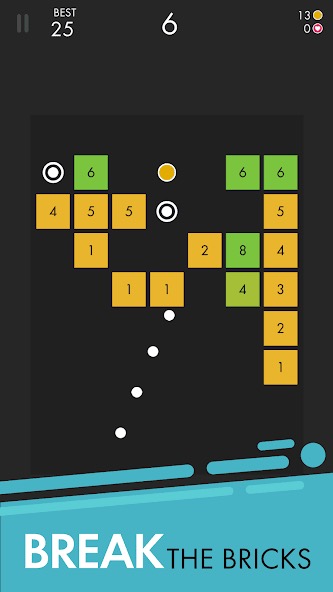
“One-finger control” can sound like marketing shorthand for a shallow game. In practice, it is one of mobile design’s most demanding constraints. Removing buttons does not remove decisions; it forces every decision through timing, direction or duration. Ballz, BADLAND and Dancing Line use that constraint in three sharply different ways, and their differences explain why simple input sometimes creates lasting depth.
Ballz turns direction into planning
Ballz asks for a drag, an angle and a release. Once the volley begins, control temporarily gives way to observation. The interesting part is not tapping quickly but predicting how dozens of rebounds will distribute damage across a rising field of numbered blocks. A tiny change in launch angle can create a long side-channel loop or waste most of a volley against the wrong target.
This alternating rhythm—plan, release, watch, reassess—is unusually suited to a phone. You can pause between turns without losing a complicated control state. The screen communicates almost everything through trajectories and numbers. When a shot works, the cascade feels generous; when it fails, the mistake is usually legible enough to inform the next attempt.
BADLAND makes duration expressive
BADLAND cares less about where you touch than how long you hold. That duration changes altitude, but the surrounding physics constantly changes what altitude means. A larger creature responds differently from a small one. Speed modifiers alter the time available to react. A group of clones turns one flight path into crowd management.
The control remains stable while the environment changes its context. This is a powerful way to create variety without interface clutter. Instead of adding a new button for every power-up, BADLAND modifies the body being controlled or the world acting upon it. The player keeps one familiar gesture and learns new consequences.
Dancing Line ties input to sound
Dancing Line converts a tap into a ninety-degree turn. On paper, that is even simpler. Its intended depth comes from connecting turns to musical phrasing: the player should hear the route as much as see it. A good rhythm stage lets melody anticipate geometry, so successful play feels like participating in a composition rather than merely avoiding walls.
The supplied Android listing, however, shows how fragile this promise can be. Recent reviewers report launch and advertisement problems, and the current Play rating is low. A precise rhythm game depends on reliable startup, stable timing and uninterrupted feedback. Technical friction harms every genre, but it is especially damaging when the entire appeal rests on flow.
Why constraints create identity
These games are recognizable from a few seconds of interaction because each assigns one gesture a clear role. Ballz is about spatial prediction. BADLAND is about continuous correction under changing physics. Dancing Line is about rhythmic commitment. None needs a tutorial filled with diagrams because the input is easy to state; the tutorial happens through increasingly demanding situations.
That clarity also improves accessibility in a practical, though not universal, sense. A game requiring one thumb can work while standing on a train or holding a phone in one hand. It reduces missed virtual buttons and allows larger touch targets. Accessibility still depends on visual contrast, timing options and motor demands, but fewer controls create room to address those concerns.
Simplicity is not the same as fairness
A simple control scheme can still support unfair level generation, aggressive monetisation or excessive waiting. Ballz is strongest when the board creates a difficult but interpretable angle problem. It is weaker when a run feels determined by an unhelpful arrangement. Dancing Line is strongest when music teaches the route, and weakest when technical interruptions break the connection.
That distinction matters when reviewing casual games. “Easy to learn” describes the input, not the quality of the decisions. We score the full loop: whether outcomes are understandable, whether failure invites another attempt and whether the business model respects the rhythm of play.
Feedback carries the missing complexity
When controls are minimal, animation and sound must explain more. Ballz needs clear collision flashes and readable number changes because the player cannot intervene during a volley. BADLAND uses movement, scale and environmental audio to communicate a changing physical state. Dancing Line depends on the beat to make an upcoming turn feel anticipated rather than guessed.
This is why superficial copies often feel flat despite sharing the same input. They reproduce the swipe or tap but not the feedback system that makes consequences understandable. The gesture is only the beginning; depth comes from the quality and variety of the responses it triggers.
Choosing the right one-finger game
Pick Ballz when you want a quiet, turn-based puzzle that can survive interruptions. Pick BADLAND when you want atmosphere, physical movement and escalating reaction demands. Dancing Line has the most direct musical premise, but its current Android sentiment warrants checking recent compatibility reports before installing.
The best one-finger games do not feel reduced. They feel distilled. Their designers remove the parts that do not belong on a phone and spend the saved complexity on levels, feedback and consequences. That is why a swipe, a hold or a tap can remain interesting long after a screen full of virtual controls becomes tiring.