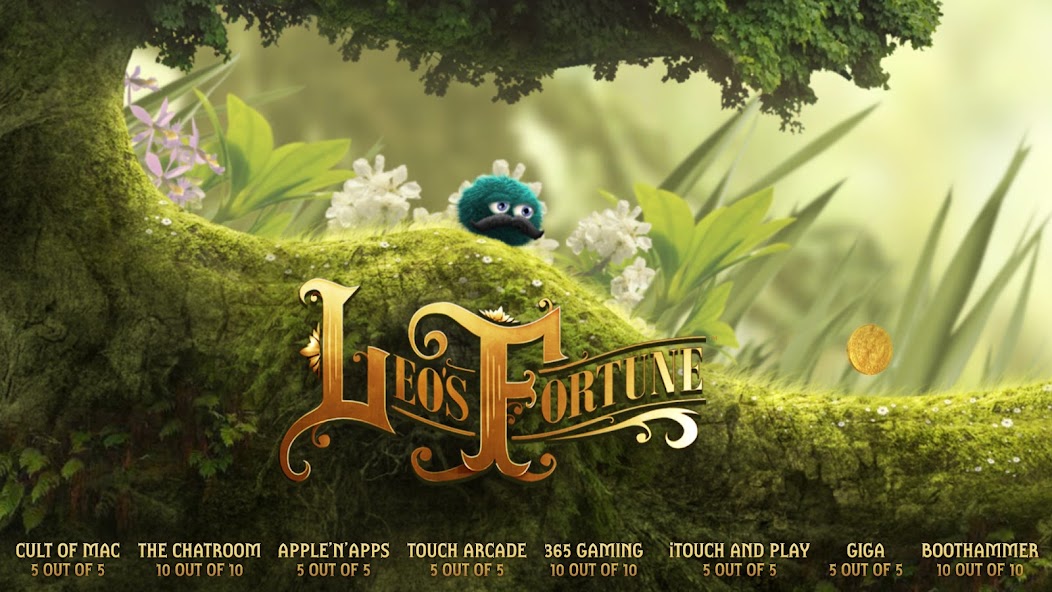
Mobile platformers have always had a slightly unfair job. They are asked to reproduce a genre built around physical buttons on a sheet of glass, fit meaningful levels into sessions that might end when a bus arrives, and justify either a price tag or a stream of interruptions. Leo’s Fortune and BADLAND succeed because neither tries to pretend a phone is a tiny console. Both begin with the limits of touch and build outward.
Two approaches to touch
Leo’s Fortune gives you a broad vocabulary: movement, inflation, jumps and momentum-based puzzle solving. The controls are virtual, but the levels leave enough room to read the result of each gesture. That generosity matters. A difficult jump feels like a problem to solve rather than a fight with the interface. The best sections combine slopes, moving platforms and pressure-sensitive timing without demanding finger gymnastics.
BADLAND goes in the opposite direction. One touch controls altitude while physics supplies the drama. Press and the creature rises; release and gravity takes over. The apparent simplicity allows the level designers to change size, speed, group count and environmental force without teaching a new button. You understand the input immediately, yet continue learning its consequences.
Craft you can feel
Premium mobile games are often discussed in terms of what they remove: no aggressive advertisement break, fewer currencies, less pressure to return on a schedule. That is useful, but incomplete. The stronger argument is what a focused business model lets designers add. Leo’s Fortune can pace a quiet landscape before a trap sequence because every second does not need to push a purchase. Its handcrafted look supports a coherent journey rather than a rotating content calendar.
BADLAND includes advertising and in-app purchases in its current Play listing, yet its original design still has the confidence of a complete game. The silhouettes are not decoration pasted over familiar obstacles. They control what information the player receives. Foreground branches hide danger, light reveals safe routes, and audio often warns you before the screen does.
Level design over content volume
Leo’s twenty-four main levels sound modest beside games promising endless play, but a finite campaign can be a strength. Each environment introduces a mechanic, explores it, combines it with an earlier idea and moves on. Hardcore mode then asks experienced players to reinterpret familiar spaces under harsher conditions. Replay value comes from mastery rather than repetition.
BADLAND is broader: a substantial single-player campaign, local multiplayer, cooperative play and a level editor. Its value lies in variety, but the memorable moments remain authored ones—the first time the flock multiplies, a corridor changes speed, or survival requires sacrificing part of the group. More content works because the central physical system remains readable.
Why Leo takes first place
Our ranking gives Leo’s Fortune a narrow advantage because it is the cleaner recommendation today. The purchase model is direct, the scope is clear and the presentation remains remarkably cohesive. Someone asking for one polished Android adventure can understand exactly what they are getting. BADLAND offers more modes and a more unusual atmosphere, but its current free-to-play framing introduces more variables.
This is not a verdict that one design is objectively superior. If local multiplayer or an eerie, reactive world matters most, BADLAND may be your personal number one. The scores indicate the strength of the complete package, not a command about taste.
The lesson for mobile design
Both games demonstrate that touch controls work best when they are treated as a material rather than a compromise. A good mobile platformer does not shrink a controller layout until it fits. It reduces inputs, enlarges meaningful gestures and designs obstacles around the amount of precision a hand can reasonably provide on a moving device.
That design discipline also changes difficulty. Failure can be demanding without feeling arbitrary when the game uses a small, consistent input set. Leo asks you to understand momentum before combining it with hazards. BADLAND lets you learn the weight of a creature before modifiers disrupt that knowledge. In both cases the challenge grows from a rule the player has already touched, not from a surprise control prompt.
Their visual restraint contributes to readability as well. Leo uses rich scenery but separates hazards from decorative layers. BADLAND turns silhouettes and contrast into navigational information. On a small display, that hierarchy matters as much as raw image quality. A beautiful scene that hides the next decision is weaker game design than a scene that directs attention without an arrow.
That lesson is why these older releases remain useful references. Technology dates quickly; clear interaction design does not. When choosing between them, start with the mood you want: Leo for a polished, story-led journey, BADLAND for physical chaos and atmospheric experimentation. Either choice shows what mobile platforming can achieve when its controls and levels are designed together.